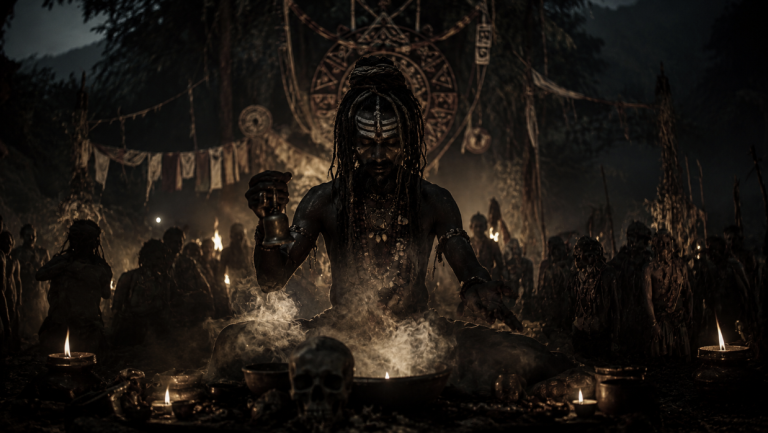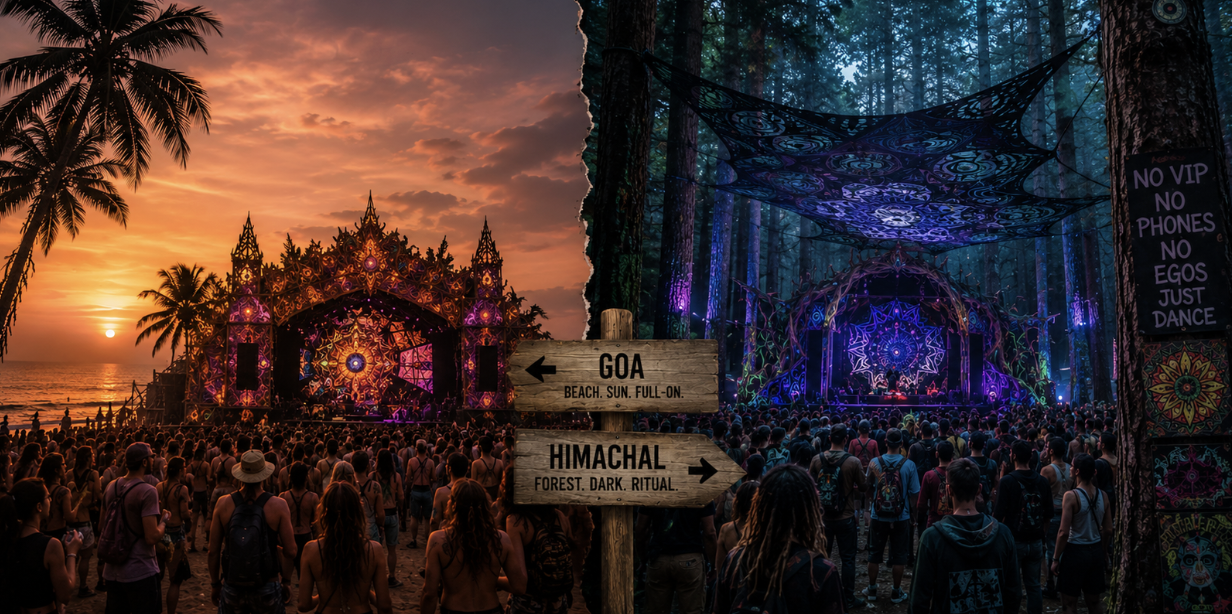

In India’s psychedelic underground, the year is divided geographically.
Winter belongs to Goa.
Summer belongs to Himachal.
By February, thousands gather beneath the palm-covered slopes of Vagator for massive Full-on lineups, sunrise sets, and increasingly elaborate festival productions. By May, much of that same crowd has migrated north into the Parvati Valley, where the music gets faster, darker, and far less interested in accessibility.
For years, outsiders treated the Indian psytrance scene as a singular mythology – Goa beaches, fluorescent fabric, endless trance rituals under tropical skies. But somewhere between commercialization, techno crossover, Instagram aesthetics, and the rise of the mountain circuit, that mythology fractured.
What exists now is less a unified scene than a seasonal split-screen culture: one coastal, expansive, and increasingly professionalized; the other isolated, high-intensity, and fiercely underground.
The divide is not just musical. It shapes booking philosophy, crowd behavior, festival design, and what people psychologically seek from the dancefloor itself.
Goa remains the symbolic capital of global psytrance culture, but the contemporary scene looks very different from the loose beach-party mythology that still dominates popular imagination.
The modern ecosystem is highly organized. Institutional venues like Hilltop now function less like improvised gatherings and more like seasonal cultural infrastructure – balancing underground credibility with large-scale festival economics.
That evolution became especially visible between 2023 and 2025 as major festivals adopted multi-stage formats designed around audience segmentation. Main stages continued serving high-energy Full-on psytrance, while secondary stages increasingly moved toward techno, progressive house, and crossover sounds.
The emergence of techno-oriented spaces like the Genesis Stage reflects a deeper shift in the Indian festival economy. Organizers understand that genre purity is commercially limiting. Today’s audience is largely urban and genre-fluid – moving between techno festivals, warehouse parties, EDM events, and psytrance gatherings without treating them as separate cultural worlds.
Goa adapted accordingly.
This has created a strange coexistence on the dancefloor. Longtime psytrance dancers remain attached to the emotional momentum of Full-on and Twilight music, while newer crowds often approach festivals through atmosphere, aesthetics, and social experience rather than total immersion.
The booking strategy reflects this balance. Goa increasingly relies on recognizable artists like Tristan, Avalon, and Ace Ventura – acts associated with polished, large-scale, emotionally accessible psytrance.
The sound itself mirrors the environment: clean production, melodic payoff, massive outdoor energy, and daytime-friendly momentum typically sitting between 135–148 BPM.
Visually, Goa has become increasingly cinematic. LED architecture, projection mapping, UV installations, and hyper-produced stage environments now play a central role in the experience.
The dancefloor has become highly visible – and increasingly designed to be documented.
That shift carries a contradiction. Psychedelic culture historically positioned itself against performative identity and social visibility. Yet modern festivals often reward exactly those things. The dancefloor once functioned as a place to disappear. Now it frequently functions as a place to be seen disappearing.
Still, reducing Goa to commercialization misses why it continues to matter. Even within its polished infrastructure, moments of genuine collective intensity still emerge – particularly during sunrise sets where the scale of the environment briefly dissolves individual identity into rhythm and atmosphere.
But somewhere over the last decade, the center of underground gravity shifted northward.
By late spring, the circuit migrates into Himachal Pradesh.
The transition feels symbolic. Tropical openness gives way to forests, cliffs, cold air, and physical isolation. The music changes with the geography itself.
In Goa, psytrance often feels expansive and outward-facing. In Himachal, it becomes denser, darker, and psychologically interior.
The Parvati Valley has gradually established itself as the sanctuary of India’s more extreme psychedelic spectrum – Forest, Darkpsy, Hi-Tech, and experimental subgenres that resist mainstream accessibility.
The difference is immediately audible.
Forest psy rejects the linear emotional payoff structures common in Full-on music. Tracks mutate instead of resolving. Rhythms feel organic and unstable. Sound design becomes textural and disorienting rather than euphoric.
The environment amplifies these qualities. A mountain forest set behaves differently from an open beach festival. Visibility narrows. Temperatures drop. Dancers remain locked into long nighttime sessions with fewer social interruptions.
The atmosphere becomes less celebratory and more hypnotic.
This is partly why Himachal developed its reputation for “ritualistic” psychedelic culture. Not because the environment is inherently mystical, but because the conditions encourage prolonged psychological immersion through isolation, exhaustion, altitude, and duration.
Its booking philosophy reflects that intensity.
Unlike Goa’s headliner-driven economy, Himachal increasingly revolves around labels and curatorial identity. Festivals associated with labels like Parvati Records attract crowds specifically interested in niche strains of Forest and Darkpsy rather than broad festival appeal.
In that sense, Himachal currently functions less like a festival market and more like an underground research zone.
The rise of marathon-style gatherings reinforces this distinction. Multi-day and multi-week festivals create temporary parallel ecosystems where travelers, artists, cafés, and local economies merge into seasonal ritual circuits rather than isolated weekend events.
But the mythology surrounding Himachal often hides its own contradictions.
The same isolation that preserves underground identity also creates environmental strain, fragile infrastructure, and a culture that can sometimes romanticize instability. Even anti-commercial scenes develop their own forms of status and exclusivity.
Both Goa and Himachal perform authenticity differently.
Meanwhile, external pressures continue reshaping both regions.
In Goa, curfews and regulatory crackdowns have accelerated the rise of after-party culture in indoor venues, disrupting the classic open-air sunrise continuity that once defined the Goa trance experience.
In Himachal, the response has been different. Rather than moving indoors, gatherings move deeper into remote terrain or stretch across longer durations where visibility becomes harder to regulate.
At the same time, parts of the international psytrance circuit have slowly begun shifting beyond India altogether.
Over the last few years, destinations like Koh Phangan have emerged as major alternative hubs for the global psychedelic community, attracting many of the long-stay travelers, organizers, and seasonal international crowds that once treated Goa as the unquestioned center of the circuit.
The reasons are partly practical. Thailand offers fewer regulatory disruptions, stronger tourism infrastructure, easier long-duration stays, and a more flexible environment for beach-jungle party culture. As noise restrictions, rising costs, policing, and commercial festival pressures intensified in Goa, parts of the international underground quietly redirected themselves elsewhere.
Goa still retains enormous symbolic power. Its mythology remains foundational to the global psytrance imagination. But increasingly, its role is shifting from permanent global center to historical and cultural origin point within a much larger transnational circuit.
Ironically, the culture born in Goa is now dispersing further away from Goa itself.
And perhaps that dispersal reflects the deeper condition of the modern psychedelic underground.
Because despite endless conversations about authenticity, India’s psytrance ecosystem was never truly unified. Goa itself emerged through collisions between tourism, migration, electronic experimentation, backpacker culture, and countercultural fantasy.
What feels different today is the speed of mutation.
Genres collapse into each other faster. Visual aesthetics circulate instantly online. Producers increasingly design tracks aware of how they will function both on dancefloors and on social media feeds.
Yet beneath all the fragmentation, certain constants remain intact.
People still travel across the country searching for altered states they cannot fully explain. Dancefloors still suspend ordinary social behavior. Rhythm still reorganizes bodies into temporary collective systems.
Somewhere between Goa’s massive sunrise spectacles and Himachal’s dense forest nights, the Indian psychedelic underground continues searching for forms capable of surviving modernity without being entirely consumed by it.
For now, the migration continues – season after season, coastline to mountain, India to Thailand, spectacle to immersion – holding together a culture that increasingly survives not through unity, but through tension itself.