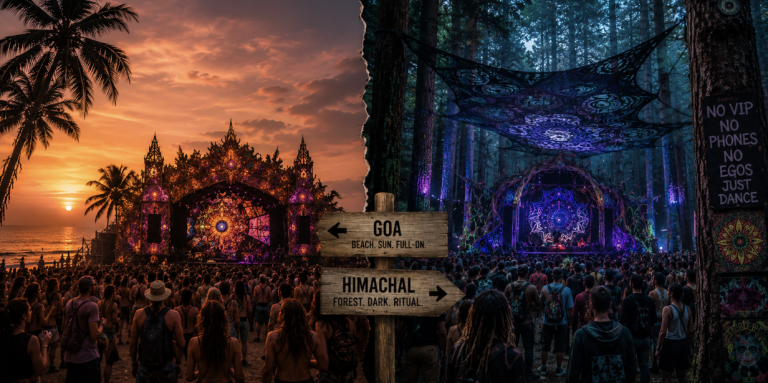

Around four in the morning at a forest gathering somewhere in Himachal, the dancefloor usually reaches a strange threshold. The decorative mythology has faded into the background by then. Nobody is looking at the UV mandalas anymore. The temperature has dropped. Bodies move with less performance and more instinct. The kick drum becomes less like music and more like weather – repetitive enough to dissolve linear thought, detailed enough to keep the nervous system alert.
For a few hours, the dancefloor stops behaving like a party.
It starts behaving like an old human technology.
That tension – between rave and ritual, between imported subculture and something far older embedded in the geography itself – sits at the center of India’s relationship with psychedelic electronic music. Because despite the common narrative that psytrance arrived in India through Western backpackers and Goa beach culture, the deeper architecture of trance on the subcontinent predates electronic music by centuries, perhaps millennia.
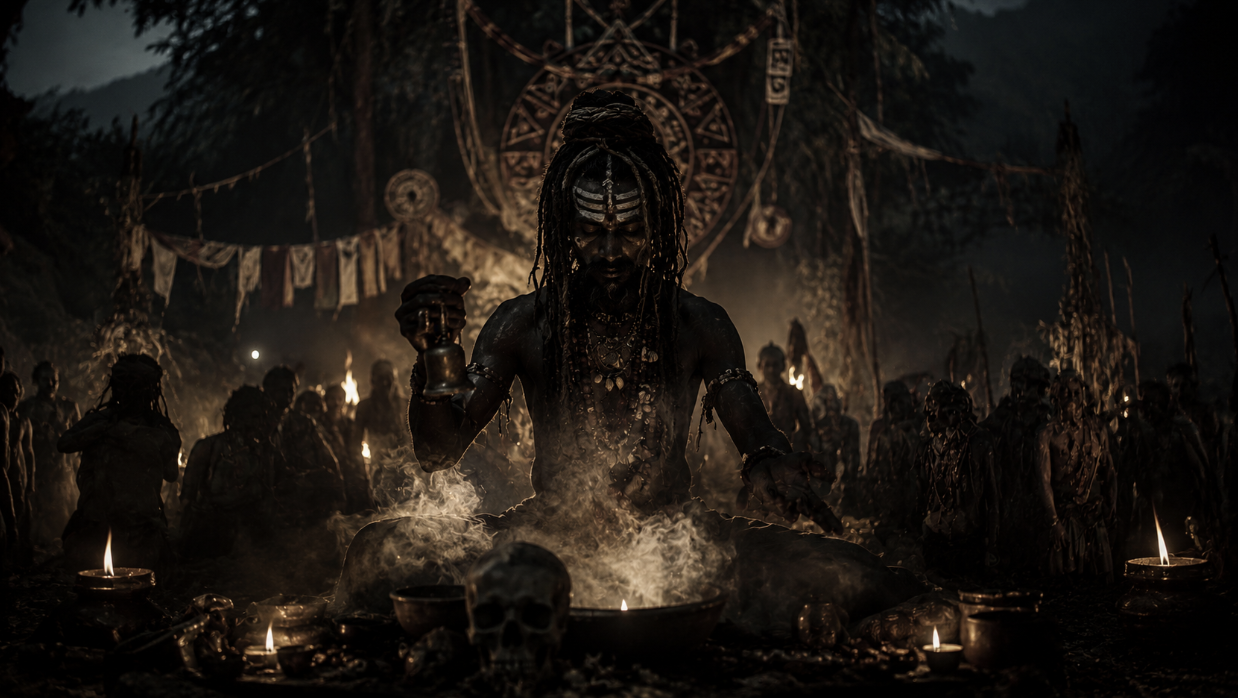
Long before sequencers, DAWs, Funktion-One stacks, or sunrise sets, India already possessed highly developed systems for using rhythm, repetition, vibration, and sonic immersion to alter consciousness. What modern psytrance culture often frames as psychedelic discovery was, in many regions of India, already part of ritual practice, healing systems, devotional traditions, and collective ceremonies.
The technology changed. The underlying mechanisms did not.
The modern psytrance producer manipulating resonant filters at 148 BPM may have more in common with the temple percussionist, the Vedic chanter, or the tribal shaman than contemporary club culture likes to admit.
And perhaps that is why the genre rooted itself here so deeply.
Not because India was exotic.
Because India was already fluent in trance.
The history of altered-state sound in India does not begin with Goa in the 1970s. It begins with a civilization that treated vibration as infrastructure.
Within ancient Indian philosophy, particularly the framework of Nada Yoga, sound was not considered entertainment or aesthetic decoration. It was understood as a fundamental organizing principle of existence itself. The phrase Nada Brahma – “the universe is sound” – was less of a mystical slogan than a perceptual model. The idea suggested that consciousness, matter, emotion, and bodily states could all be influenced through frequency and resonance.
That perspective produced highly sophisticated sonic systems.
Raga Chikitsa, an ancient therapeutic framework, mapped emotional and physiological states through melodic structures. Specific ragas were associated with different times of day, moods, internal energies, and psychological conditions. Sustained drones encouraged slower breathing patterns and altered attention states. Repetition was not compositional laziness. It was neurological strategy.
Even today, certain forms of Indian classical performance can feel structurally closer to ambient hypnosis than conventional Western composition. The gradual unfolding of tonal space. The cyclical return to micro-variation. The suspension of climax. The patience.
In many ways, the modern psychedelic obsession with “journey-based” music already existed inside Indian sonic philosophy long before electronic genres formalized the concept.
The same applies to rhythm.
Anthropologists and neuroscientists now describe trance induction through concepts like auditory driving and neural entrainment – the synchronization of brainwave patterns to repetitive rhythmic stimuli. But ritual drumming cultures across India operationalized these principles long before they were academically named.
The Chenda Melam traditions of Kerala are perhaps one of the clearest examples. Experienced live, they can feel physically overwhelming: dense polyrhythmic percussion escalating in cycles of tension and release, creating a collective psychological acceleration inside crowds gathered during temple festivals.
The important detail is that these traditions were not trying to create passive listeners.
They were engineering participation.
The same pattern appears in tribal ritual practices across the North-East, where drums historically functioned not only as instruments but as communication systems, healing devices, and spiritual mediators. Long-duration dancing, repetitive pulse structures, exhaustion-induced transcendence – the mechanics are strikingly familiar to anyone who has spent enough time inside psytrance culture.
Perhaps the biggest misconception surrounding Goa and the birth of psytrance is the assumption that trance culture itself was imported into India by Western travelers. Electronic dance music was. The ritual logic underlying trance was not.
Long before sequencers arrived on the beaches of Anjuna, the subcontinent already possessed highly developed traditions built around repetition, resonance, ecstatic dance, breath synchronization, devotional rhythm, and altered-state sound. What the Goa movement introduced was not trance itself, but a new technological language through which trance could be experienced.
In that sense, the hippie trail did not “bring” psychedelic ritual to India. It stumbled into a civilization that had been experimenting with sonic transcendence for centuries.
The modern iteration of the Indian Ritual Circuit began taking shape in the late 1960s and early 70s, when Goa became a sanctuary for Western travelers, dropouts, musicians, seekers, smugglers, mystics, and drifters moving across the old hippie trail.
At first, the soundtrack was still largely rock music – The Grateful Dead, Pink Floyd, The Doors. Then came the electronic transition: Kraftwerk, EBM, industrial textures, stretched edits, looped passages, pitch manipulation. DJs began extending tracks beyond their intended structure, removing vocals, sustaining grooves, and prioritizing hypnotic continuity over song format.
In hindsight, this moment feels crucial.
Because Goa trance did not emerge from the logic of nightclub culture. It emerged from attempts to prolong altered states.
That distinction shaped everything that followed.
By the early 1990s, the Goa sound had developed its own recognizable language: elongated arrangements, spiraling melodies, acid sequences, Eastern scales, ceremonial pacing. Sets were structured less like entertainment programming and more like endurance rituals. Goa Gil became the defining archetype – not simply as DJ, but as something closer to ritual facilitator. His marathon sets reframed the DJ booth as ceremonial infrastructure.
The ritual intensity that Goa Gil cultivated through all-night ceremonial sets did not disappear with the decline of Goa’s original beach culture. It mutated. In the mountain circuits of the 2000s, labels like Parvati Records shifted the focus away from euphoric melody toward denser psychological environments – music that behaved less like dance entertainment and more like environmental immersion.
Forest psy and darkpsy pushed trance music deeper into texture, repetition, and psychoacoustic tension. The bright melodic euphoria of classic Goa gradually gave way to insect-like percussion, unstable atmospheres, and increasingly organic sound design.
Good forest music rarely feels clean.
It feels alive.
Tracks associated with Parvati Records often resemble ecosystems more than compositions. Sounds mutate. Rhythms destabilize perception. Tiny sonic details emerge and disappear at the edge of awareness. Instead of obvious emotional release, the experience becomes immersive disorientation.
This is partly why forest psy resonated so strongly within India’s mountain regions. The environment itself already carried psychological ambiguity: altitude fatigue, isolation, darkness, weather instability, and prolonged social immersion. The music amplified those conditions rather than escaping them.
At its best, the genre became a form of environmental psychology through sound.
And yet beneath all the sonic evolution, the core mechanics remained ancient.
Repetition.
Entrainment.
Collective synchronization.
Sensory overload.
Ego destabilization.
Communal release.
The tools became digital. The ritual architecture stayed remarkably similar.
That continuity matters because it complicates simplistic narratives about psytrance as imported counterculture. The modern scene may use laptops instead of temple percussion, modular synthesis instead of ritual chanting, and sound systems instead of ceremonial courtyards. But the deeper human impulses behind the experience are astonishingly old.
Even today, the most powerful moments inside psychedelic dance culture often emerge not from spectacle, but from synchronization – those rare stretches of time where hundreds of people lock into rhythm so completely that individuality temporarily softens around the edges.
Historically, India has always possessed frameworks for understanding such states.
Not necessarily as entertainment.
Not even as escapism.
But as temporary reorganizations of consciousness through sound.
That may ultimately explain why psychedelic electronic culture continues to root itself so deeply within the subcontinent despite changing trends, migrating scenes, and evolving technologies.
Not because India became the spiritual backdrop for Western rave mythology.
But because the architecture for trance was already here long before the first kick drum arrived on a Goa beach.
Modern psytrance did not invent India’s relationship with altered-state sound.
It digitized it.